Vienna has more layers than most European capitals. You walk over Roman ruins, through baroque squares, past Gründerzeit boulevards and the social housing of Red Vienna. These layers aren’t tucked away in museums - they sit on top of each other in the streetscape, often just minutes apart. To understand Vienna you don’t need a history book, you need good shoes. Eight places where the history becomes visible, in chronological order, so you can walk them as a journey through time.
1. Hoher Markt (Ancient Vindobona)
Vienna started as a Roman military camp. The remains of Camp Vindobona lie beneath Hoher Markt in the 1st district, and a small museum (Römermuseum) puts them on display: foundations of officers’ houses, underfloor heating, everyday objects the legionaries left behind. Legend has it that Emperor Marcus Aurelius died in this area. This is where the city’s oldest chapter ends: 1st century into the 5th, then the Romans withdrew and Vindobona faded into obscurity for centuries. Hoher Markt itself is unremarkably built up today, but the Ankeruhr on its eastern side deserves a look: at noon, all twelve figures of the art nouveau musical clock parade past, from Marcus Aurelius to Joseph Haydn - a city history in miniature.
2. St. Stephen’s Cathedral (Middle Ages)
First church in the 12th century, Gothic construction from 1359. The south tower was Central Europe’s tallest for over 400 years, and the Viennese still affectionately call it the “Steffl”. The Giant’s Door on the west side is Romanesque, the rest Gothic - you can read the building history off the building itself. Stephansplatz as the city centre hasn’t moved since the Middle Ages: what’s now a pedestrian zone with souvenir shops was once market and meeting ground. Inside the cathedral, look for the pulpit by Anton Pilgram, who immortalised himself as the “Fenstergucker” peering out from under the staircase, one of the city’s earliest artist self-portraits. Climb the 343 steps of the south tower and you’ll see the colourful tiled roof with its double-headed eagle from above.
3. Heldenplatz and the Hofburg (Habsburgs)
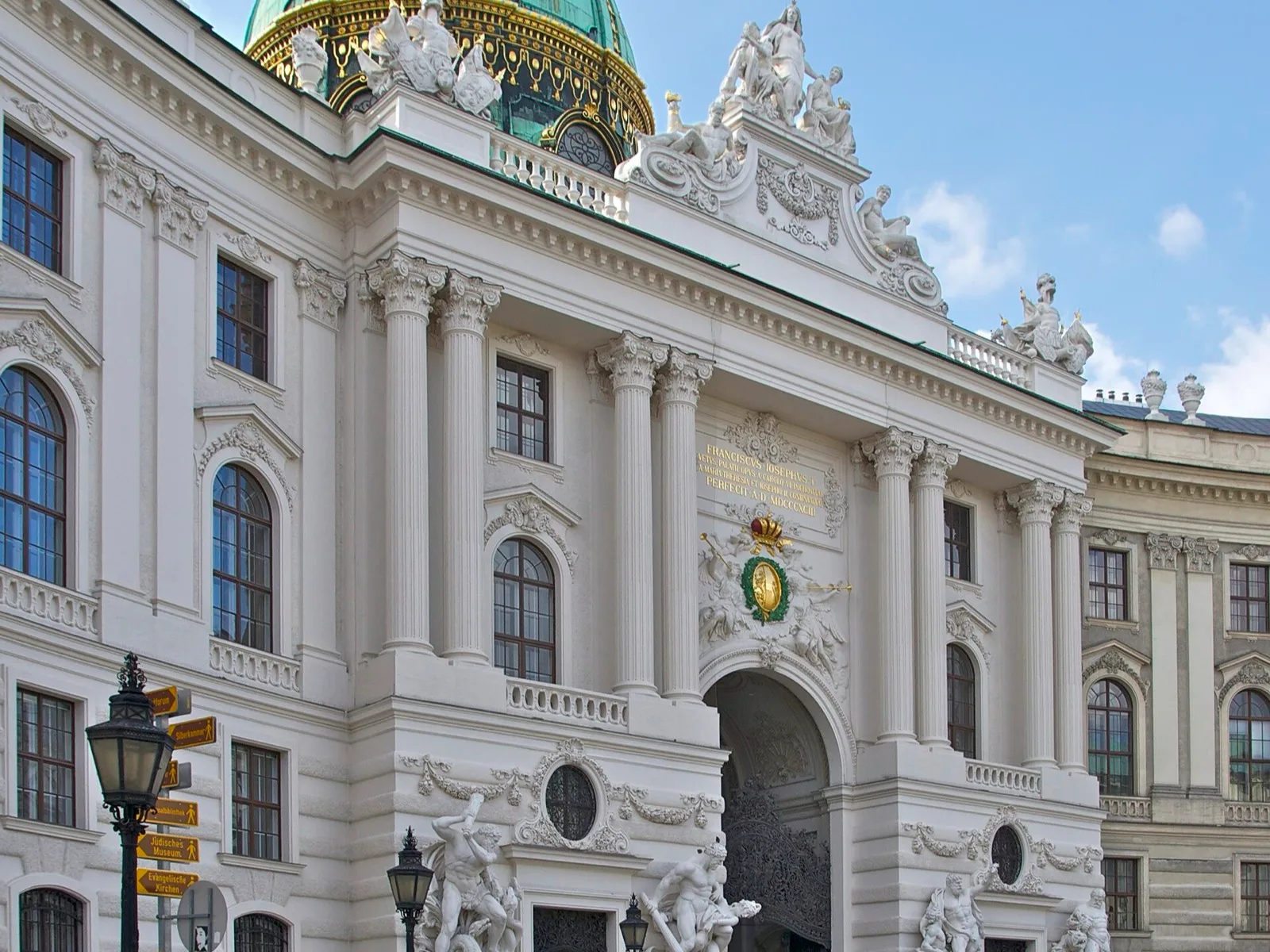
The Hofburg grew from the 13th century onwards over 600 years - every generation of rulers added on, hardly any tore down. Oldest part: the Schweizerhof (13th century), newest: the Neue Burg (1913). The result is a conglomerate of Gothic, Renaissance, Baroque and Historicism you can read like tree rings. Heldenplatz is named after Archduke Charles (1771-1847) and Prince Eugene, whose equestrian statues stand there. From the balcony of the Neue Burg, Hitler announced the “Anschluss” in 1938 - which makes the square the most burdened site in Austria’s modern history. Today the Hofburg is the seat of the Federal President, plus the Sisi Museum, the imperial apartments and the National Library with its baroque State Hall, one of the most beautiful library rooms in the world.
4. Schönbrunn (Baroque and Enlightenment)
Maria Theresia had the palace completed in 1743 - the Habsburgs’ answer to Versailles, just in yellow. 1,441 rooms. Marie Antoinette grew up here, Mozart played for the court at age six, the Empress died here in 1780. The gardens, the Gloriette and the zoo (the world’s oldest still operating, founded in 1752) come with it. Schönbrunn tells the story of the era in which Vienna transformed from a bulwark against the Ottomans - the second Turkish siege of 1683 was still in living memory - into the confident residence of a great power. The park is free to enter year round; the climb up to the Gloriette rewards you with the classic view over palace and city.
5. Ringstraße (Gründerzeit)
In 1857, Emperor Franz Joseph ordered the city walls torn down. On the cleared glacis rose the Ringstraße: State Opera (1869), Kunsthistorisches and Naturhistorisches Museum (1891), City Hall (1883), Parliament (1883), University (1884), stock exchange, Burgtheater. Within 30 years Vienna reinvented itself as a metropolis. Each building chose the style that matched its function: the Parliament Greek-antique (democracy), the City Hall neo-Gothic (civic freedom), the University neo-Renaissance (humanism). The best way to experience the Ring: a loop by tram - lines 1 and 2 together cover almost the entire arc.
6. Belvedere (Klimt and Viennese Modernism)
The Upper Belvedere, Prince Eugene’s baroque summer residence, now holds the key paintings of Viennese Modernism: Klimt’s “Kiss” (1908), Schiele’s “Death and the Maiden” (1915). The contrast is both deliberate and a stroke of luck - baroque shell, radical content. Around it you’ll find the buildings of the era: the Secession with its golden dome (founded 1897 as a counter-movement to the Academy), Otto Wagner’s Postsparkasse (1906), and Adolf Loos’s deliberately unadorned Looshaus on Michaelerplatz (1911), which reportedly annoyed Franz Joseph so much he avoided looking at it. Around 1900, Vienna was briefly the intellectual centre of Europe: Freud, Mahler, Wittgenstein, Klimt and Schiele were all working in this city at the same time.
7. Karl-Marx-Hof (Red Vienna)
After 1918 - the end of the monarchy and proclamation of the republic - Vienna became a social-democratic laboratory. Between 1919 and 1934 the city built around 60,000 social-housing units, financed through dedicated taxes. The Karl-Marx-Hof in the 19th district, stretching a good kilometre, is the most famous building of that era: a “residential fortress” with courtyards, baths, kindergartens and laundries, conceived as the antithesis of the dark tenement blocks of the Gründerzeit. During the February fighting of 1934, Austria’s brief civil war, the building came under fire - the end of Red Vienna. It stands in the district of Döbling, right by the subway, and is still lived in today. Vienna’s council-housing tradition lives on, by the way: a large share of the Viennese still live in subsidised flats.
8. Judenplatz and Holocaust memorial (20th century)
Rachel Whiteread’s memorial (2000) remembers the 65,000 murdered Austrian Jews: a library turned inside out, cast in concrete, its books impossible to open. Next to it is the Museum Judenplatz with the remains of the medieval synagogue, destroyed in a pogrom in 1421. Two catastrophes, five centuries apart, on one quiet square. Judenplatz hides just behind Hoher Markt, which brings this route full circle: start and end are separated by two minutes on foot and two thousand years.
To turn it into a walk
A three-hour walk from Hoher Markt via Stephansdom, Hofburg and the Ring to the Belvedere covers six of these points - all of them lie in or on the edge of the Innere Stadt. Schönbrunn is its own half-day trip (U4 to Schönbrunn or Hietzing), the Karl-Marx-Hof a short detour on the U4 to Heiligenstadt - the building sits directly opposite the station. Best time for the inner-city stages: early morning, before the tour groups flood Stephansplatz and Heldenplatz. Staying central saves you travel time - many hotels sit within walking distance of this route, and for historic atmosphere at night too, browse the historic hotels category.
Frequently asked questions
Do I need tickets for these places? Not for the streets and squares, naturally. You pay for the Römermuseum, the interiors of the Hofburg, Schönbrunn and Belvedere, and the tower climb at St. Stephen’s. The Judenplatz memorial, the Ringstraße and the Karl-Marx-Hof (from outside) are free.
How much time should I plan? Three to four hours are enough for the pure outdoor route through the city centre. Add museum visits and the list easily becomes a two-day programme: Schönbrunn and Belvedere each eat half a day.
Is a guided tour worth it? If you care about the details, yes - especially for the Roman era and Red Vienna, good guides tell you what the facades don’t. For a general overview, though, the route works perfectly well on your own.
Can I do the route with children? In stages, yes. The Ankeruhr at noon, the tower climb and the Schönbrunn zoo are the most child-friendly stops. The full route in one day is too much for smaller kids.