Two days in Vienna leaves you sprinting. Three is the number where the city clicks: one day for the old town, one for the palace and a great museum, and one day that is genuinely yours. This plan is built around what is actually open, how long things actually take, and how far apart they actually are, which in Vienna is less far than you expect.
A note on scale first. The historic center is a little over a square kilometer, well under a mile across, so almost everything on Day 1 is a five to fifteen minute walk from the last thing. Where you do need transit, U-Bahn (subway) lines run U1 through U6, and a multi-day Wiener Linien pass covers subway, tram and bus on one ticket.
Three words you will need
Kaffeehaus. A Viennese coffee house is not a coffee shop. It is designed for staying: marble tables, newspapers on wooden holders, waiters in vests who will not rush you. One coffee buys you two hours. A “Melange” is the local cappuccino.
Heuriger. A wine tavern in the vineyard districts where the grower pours his own young wine. You collect food from a buffet counter yourself, the wine comes to the table, and nobody hands you a check until you ask.
Beisl. A neighborhood tavern serving Viennese home cooking. Schnitzel, goulash, boiled beef, wood paneling, no concept.
Day 1: The old town on foot
8am, breakfast in a coffee house. Forty-five minutes minimum, ideally longer, because sitting still in a Kaffeehaus is not a break from the sightseeing, it is part of it.
9am, St. Stephen’s Cathedral. The city’s symbol, Gothic, with a south tower rising 136.4 meters, about 448 feet. The entrance area is free; tickets are needed for the main nave, the towers, the catacombs and the treasury. The south tower is climbed on foot, 343 steps, no elevator; the north tower has a lift and holds the Pummerin, the great bell. Budget 60 to 90 minutes including the climb. The roof above you carries around 230,000 glazed tiles laid out as a double-headed eagle. Stephansplatz station sits directly underneath, on the U1 and U3.
10:30am, walk to the Hofburg. Ten minutes through Graben and Kohlmarkt, past the pastry shops. The Hofburg was the Habsburg winter residence for centuries and is now the seat of Austria’s president. The Imperial Apartments, the Sisi Museum and the Silver Collection come as one combined ticket and take about two hours; add the Imperial Treasury with the crown jewels and it is three to four. Courtyards and squares are free year-round, so skipping the interiors still gets you the walk from Michaelerplatz to Heldenplatz.
If horses interest you more than furniture, the Spanish Riding School is in the same complex. Gala performances are mostly weekends and sell out weeks ahead; weekday morning training is cheaper and easier to get into. In summer the Lipizzaner stallions relocate to Heldenberg, so the Vienna program thins out.
1pm, lunch. A Beisl in the lanes north of the cathedral. Reserve if you can, the good ones fill at noon.
2:30pm, the Albertina. Five minutes from the Hofburg on Albertinaplatz. One of the world’s great print rooms, roughly 65,000 drawings and about a million printed sheets, with Dürer, Michelangelo, Rubens, Schiele and Klimt in the holdings. The Dürer sheets are fragile and shown in rotation or as facsimiles, so do not plan your day around the “Young Hare.” The permanent “Monet to Picasso” collection and the state rooms are always up. Two to three hours.
5pm, coffee and cake. Second Kaffeehaus of the day. This is not indulgence, it is the correct use of a Viennese late afternoon.
7pm, the State Opera. Around 350 performances a season makes this one of the biggest repertoire houses on earth, and the cheapest way in is standing room, sold at the Operngasse entrance about 80 minutes before curtain, cash only. Smart clothes are expected in the stalls; standing places are casual. The season runs September through June and the house is dark in July and August, so in high summer take a daytime tour instead, offered daily outside rehearsals.
Day 2: Schönbrunn in the morning, art in the afternoon
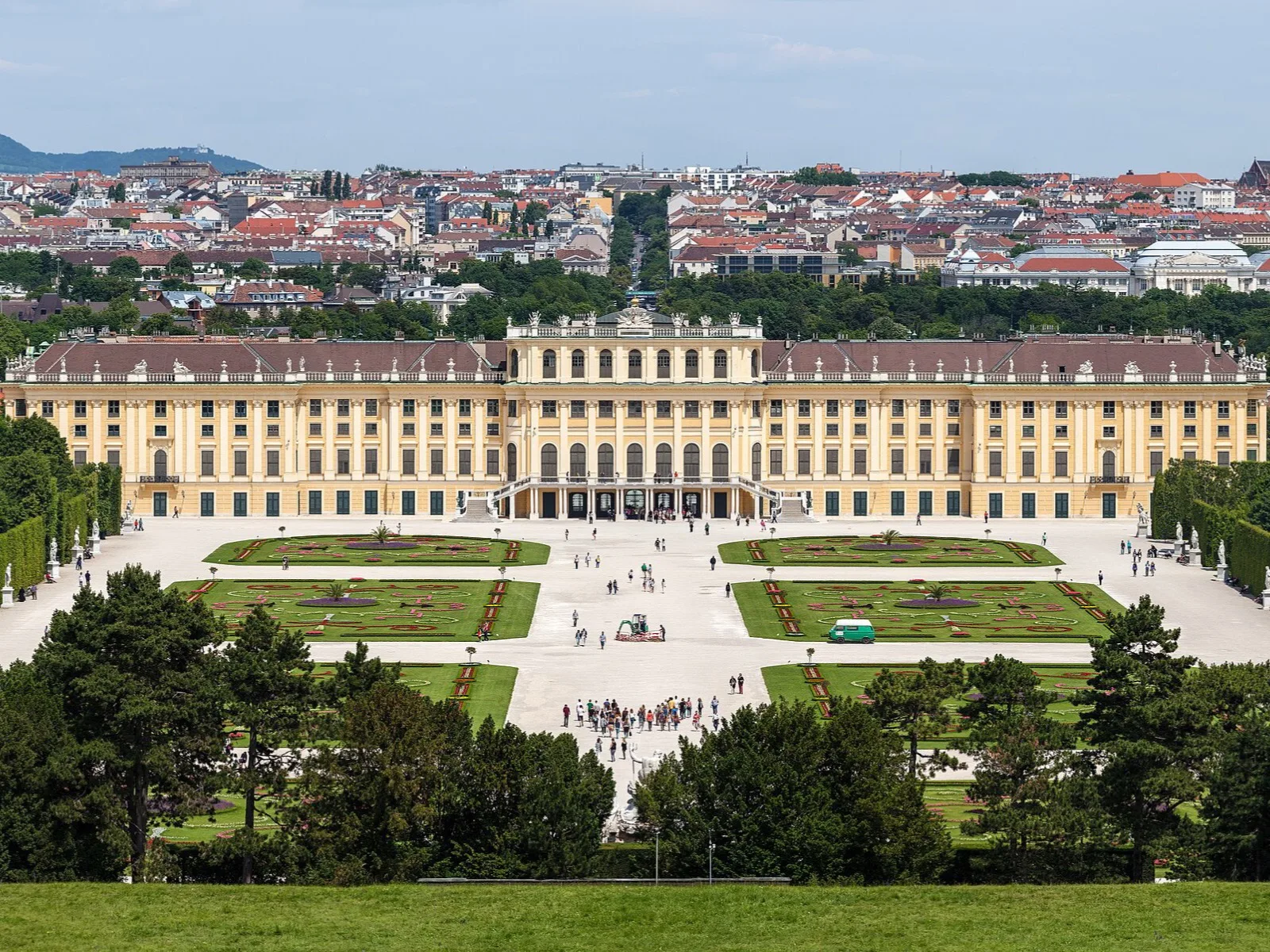
8:30am, Schönbrunn Palace. Take the U4 to Schönbrunn or Hietzing, about 15 minutes from Karlsplatz with no changes. Go early. This is the single most important piece of timing in the whole three days.
Palace tickets carry a timed entry slot, and booking ahead is strongly advised, especially in summer. The Habsburg summer residence has around 1,441 rooms, of which 40 are open to visitors, and what you see today is largely Maria Theresa’s rebuild. It has been a UNESCO World Heritage Site since 1996.
The Baroque park is free and worth as much time as the interiors: the Neptune Fountain, the maze and the Gloriette on the hill behind the palace. Note that the Privy Garden, the maze, the Gloriette and the zoo each need a separate ticket even though the main park does not. Tiergarten Schönbrunn, founded in 1752, is the oldest continuously operating zoo in the world and a half-day on its own.
Realistic budget: palace plus park is three hours minimum. Add the zoo and the Gloriette and the whole day is gone, which is fine with kids but wrecks the afternoon below.
1pm, back into town. The U4 returns you to Karlsplatz. Eat near where you are heading next.
2:30pm, pick one museum. Two candidates, both excellent. Do not attempt both.
The Kunsthistorisches Museum on Maria-Theresien-Platz is the Habsburg collection: the largest Bruegel holding in the world with twelve panels including “Hunters in the Snow,” Vermeer’s “Art of Painting,” Caravaggio’s “Madonna del Rosario,” and Cellini’s Saliera in the Kunstkammer. It opens Tuesday through Sunday with a late opening on Thursdays in most periods, so a Monday makes this decision for you. Three hours minimum, half a day for the whole thing.
The Belvedere in the 3rd district is the one to choose if Klimt is why you came. “The Kiss” hangs in the Klimt room of the Upper Belvedere, along with “Judith I.” Ninety minutes covers the Upper Belvedere; half a day if you add the free Baroque garden and the Lower Belvedere, which needs its own ticket.
6pm onward. If you took the Kunsthistorisches, the MuseumsQuartier is directly across the square: 90,000 square meters of former imperial stables, courtyards free to enter, colorful Enzi loungers, and the Leopold Museum inside holding the largest Schiele collection anywhere. Sit down. You have earned it.
Day 3: three ways to spend it
Pick one. All three are full days, and all three show you a Vienna the first two days do not.
Option A: the Prater and Leopoldstadt
Take the U1 or U2 to Praterstern, Riesenrad exit. The Prater has been open to the public since the 18th century, and the Wiener Riesenrad, the Giant Ferris Wheel, went up in 1897 for Franz Joseph’s golden jubilee. It stands 64.75 meters, roughly 212 feet, and one rotation takes about 15 minutes. Entering the Wurstelprater costs nothing; rides are paid separately and the wheel has its own ticket. Most rides run March through October, but the wheel turns year-round.
Then walk the Hauptallee, a straight chestnut-lined avenue about 4.4 kilometers long, roughly 2.7 miles, full of runners and cyclists. Afterwards, cross into the Karmeliter quarter of Leopoldstadt for its market and small restaurants, then walk 15 minutes over the Danube Canal back into the old town. On a hot day, the U1 also stops on the Danube Island, 21 kilometers of swimming meadows and bike paths, about 13 miles end to end.
Option B: Naschmarkt and Hundertwasser
Start at the Naschmarkt, Vienna’s most famous market, on the border of Wieden, reached by U1, U2 or U4 to Karlsplatz. It runs Monday to Friday from about 6am to 7:30pm and Saturday until 6pm, closed Sundays, though most restaurants along it stay open. Weekday mornings are least crowded, and on Saturdays a flea market fills the western end from about 6:30am to 6pm. The middle stalls are touristy; walk toward Kettenbrückengasse and it turns back into an ordinary neighborhood market.
The Karlskirche is right there at the Resselpark exit, a Baroque church built after a plague vow, flanked by two 33-meter columns, about 108 feet, and fitted with a panoramic lift up to the dome frescoes. The visitor entrance fee includes the lift. Late afternoon is when the sun hits the façade straight on.
In the afternoon, tram 1 to Hetzgasse for the Hundertwasserhaus in Landstraße. Irregular colors, tilting windows, trees growing out of the building, 52 apartments and four shops, and it is genuinely lived in, so there is no going inside. Twenty to thirty minutes is the honest visit length, but the Kunst Haus Wien, also Hundertwasser’s work, is five minutes away and turns this into a proper stop.
Option C: wine country and the view
The vineyard day, in Döbling. Take the U4 to its terminus at Heiligenstadt, then bus 38A to the end of the line at the Kahlenberg, a 484-meter hill, about 1,590 feet, at the edge of the Vienna Woods. From the plateau you see the whole city, the Danube and the plain beyond, and it costs nothing. This is the hill the relief army came over in September 1683 to break the second Ottoman siege.
From Cobenzl you can walk down to Grinzing along the Beethovengang in about an hour to an hour and a half, comfortably downhill through woods and vineyards. Arrive at a Heuriger in the late afternoon, order a quarter liter of Grüner Veltliner and work the buffet. Tram 38 takes you from Grinzing back to Schottentor on the Ring, 20 to 30 minutes. One warning: in winter many Heurigen close for the season, so this option is best from spring through fall.
Frequently asked questions
Is three days enough for Vienna? For the essentials, yes. You get the old town, Schönbrunn, one world-class museum and one full day of something else. What you miss is the second tier: the Zentralfriedhof with Beethoven’s and Schubert’s graves, the Musikverein, the outer districts.
What if it rains? Vienna is one of the best rainy-day cities in Europe. Swap any outdoor block for a museum, and remember that coffee houses are designed for exactly this.
Do I need to book anything in advance? Schönbrunn, yes, its tickets carry timed entry slots. Spanish Riding School gala performances, yes, weeks ahead. Dinner reservations on Friday and Saturday. Everything else you can decide on the day.
Can I do Schönbrunn on Day 1 instead? You can, but Day 1 works best on foot with no transit at all, and breaking it in half to ride out to the palace costs more time than it looks.
How much walking is this? Day 1 is nearly all on foot. Day 2 involves less walking but more standing, which is harder on the feet. The old town is cobbled, so bring shoes you trust.